


Ceramic Impact Liner
Ceramic Impact Liner Manufacturer & Global Supplier
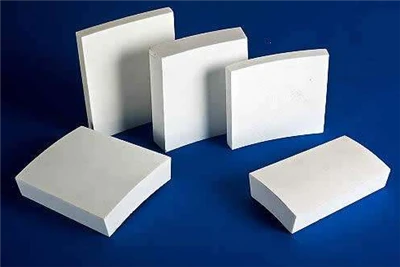
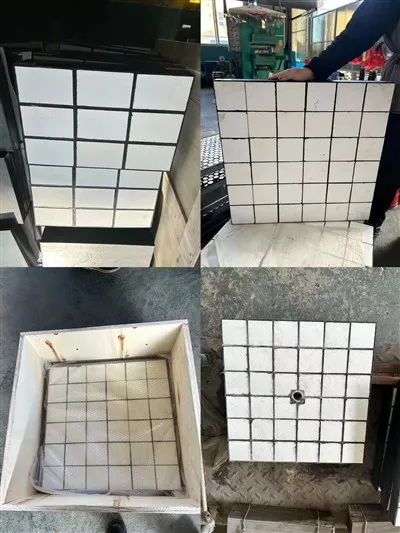
We manufacture composite ceramic impact liners for bulk material handling areas exposed to repeated impact and abrasion. With more than 25 years of ceramic manufacturing experience, 30,000+ m² of production space, three automatic production lines and annual wear-resistant ceramic capacity of 30,000 metric tons, we supply ceramic, rubber and steel composite lining configurations for chutes, hoppers, bins and transfer points. Ceramic grade, liner structure, thickness and dimensions can be specified according to operating conditions and equipment requirements.




Why Choose Us
Established Manufacturing Experience
More than 25 years of ceramic production experience cover material processing, ceramic forming, sintering and composite liner manufacturing.
Global Supply Support
Products are prepared for international orders with defined production, inspection, export packaging and shipment processes.
Production Capacity
The production base covers more than 30,000 m², with three automatic production lines and annual wear-resistant ceramic capacity of 30,000 metric tons.
Certified Management Systems
The manufacturing system is supported by ISO 9001, ISO 14001 and ISO 45001 certifications covering quality, environmental and occupational health and safety management.
Product Performance
Abrasion Protection
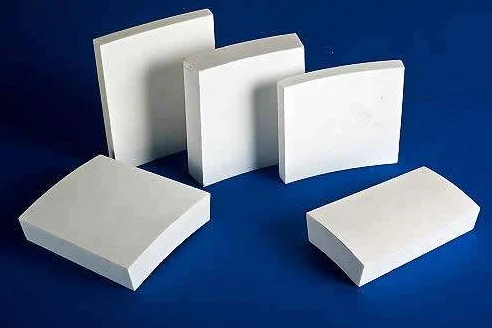
High-density alumina ceramic provides a hard working surface for continuous sliding and abrasive contact. Main alumina grades have Mohs hardness of 9 and water absorption of no more than 0.01%.
Impact Absorption
The rubber layer provides elastic support beneath the ceramic surface. It accommodates impact and vibration between the material load and the equipment structure.
Panel Strength
Steel backing adds structural rigidity to composite panels where mechanical fastening is required. The backing thickness can be selected according to the panel design and installation arrangement.
Typical Applications
Transfer Chutes
Used in transfer sections where bulk material repeatedly strikes the liner and then moves across the wear surface.
Hoppers and Bins
Suitable for loading zones exposed to direct material impact followed by abrasive contact.
Feed and Discharge Areas
Applied to areas where material enters, changes direction or leaves bulk handling equipment.
Bulk Material Handling
Typical industries include mining, mineral processing, cement, steel, coal handling, power generation and aggregate processing.
Technical Specifications
Ceramic Properties
|
Property |
92% Alumina |
95% Alumina |
ZTA |
|
Alumina Content |
≥92% |
≥95% |
75–80% |
|
Zirconia Content |
— |
— |
20–25% |
|
Bulk Density |
≥3.60 g/cm³ |
≥3.68 g/cm³ |
≥4.00 g/cm³ |
|
Water Absorption |
≤0.01% |
≤0.01% |
≤0.01% |
|
Mohs Hardness |
9 |
9 |
9 |
|
Rockwell Hardness |
≥85 HRA |
≥88 HRA |
≥90 HRA |
|
Fracture Toughness |
4.6 MPa·m½ |
4.7 MPa·m½ |
≥5.5 MPa·m½ |
Composite Construction
|
Parameter |
Typical Range |
|
Rubber Thickness |
4–10 mm |
|
Steel Backing Thickness |
3–10 mm |
|
Total Panel Thickness |
12–65 mm |
|
Panel Size |
200×200 to 500×500 mm |
|
Ceramic Tile Size |
20×20 to 150×150 mm |
|
Installation |
Bolt-on / Adhesive / Weldable Studs |
Material Characteristics: Particle size, bulk density and material flow affect the impact load and abrasive contact applied to the liner surface.
Impact Conditions: Drop height and impact angle should be considered when selecting ceramic thickness, tile geometry and backing structure.
Wear Pattern: Direct impact and sliding abrasion place different demands on the liner. Areas receiving material impact can use an impact-absorbing composite structure, while downstream surfaces can be specified according to their dominant wear pattern.
Equipment Geometry: Flat, curved and irregular surfaces may require different panel dimensions or ceramic arrangements to maintain coverage and fit.
Custom Shapes & Dimensions
Panel Dimensions
Panel length, width and total thickness can be specified according to equipment drawings and available installation space.
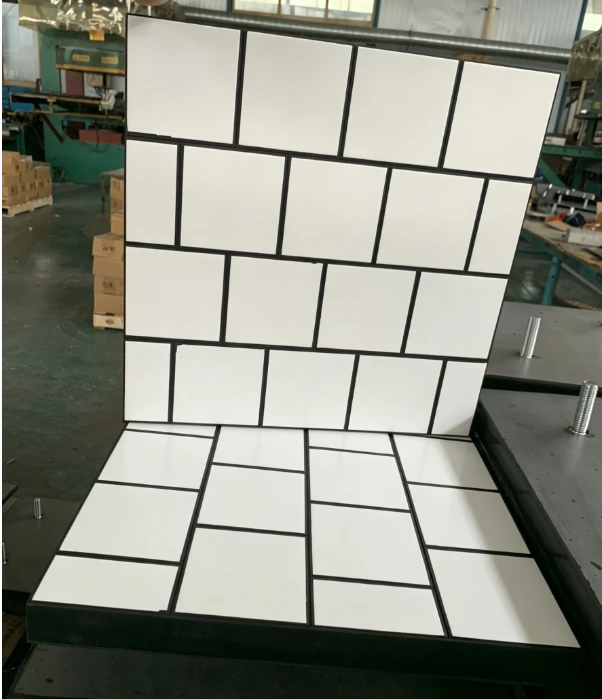
Ceramic Patterns
Square, rectangular, hexagonal and other ceramic arrangements can be selected according to surface geometry and coverage requirements.
Composite Structure
Rubber thickness, steel backing and fixing configuration can be specified as part of the overall liner design.
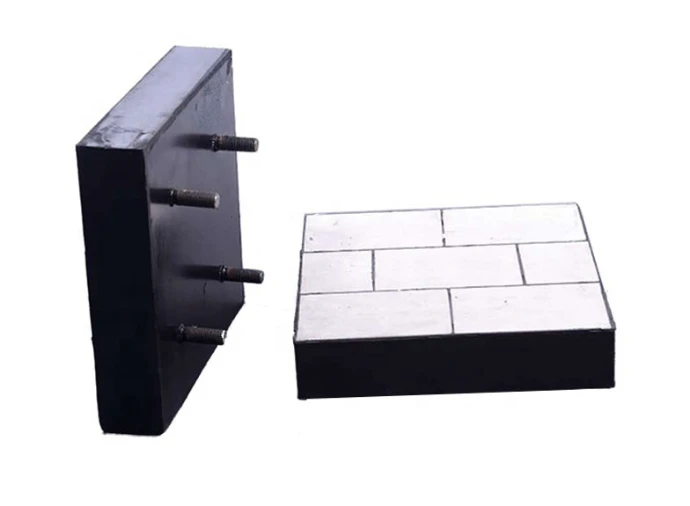
Bolt-On Installation
Steel-backed panels can be supplied for mechanical fastening where removable liner sections are required for maintenance.
Adhesive Installation
Suitable liner configurations can be supplied for adhesive bonding to prepared equipment surfaces.
Installation Matching
The fixing method should correspond to impact level, vibration, substrate condition and maintenance access. Drawings can be reviewed before production when installation geometry is complex.
Manufacturing & Quality Control
Ceramic Production
Ceramic components are processed through controlled forming and sintering stages. Dimensions and visible surface condition are checked during production.
Composite Assembly
Ceramic, rubber and steel components are assembled according to the specified liner structure, dimensions and mounting arrangement.
Final Inspection
Finished panels are checked against order requirements before shipment, including dimensions, appearance and configuration.
Technical & After-Sales Support
Product Confirmation
Ceramic grade, dimensions, structure, quantity and installation requirements can be reviewed before production.
Drawing Review
Equipment drawings and dimensional information can be assessed when a customized liner configuration is required.
After-Sales Support
Technical assistance is available for product use, installation questions and follow-up supply requirements.
Export Packaging
Composite ceramic liners are protected according to product dimensions, weight, structure and transportation requirements before international shipment.
Shipment Arrangement
Shipment arrangements can be coordinated according to the agreed order requirements and destination.
Delivery Tracking
Transportation progress can be followed through the shipment process to support delivery coordination.

What to Provide for a Quotation
Equipment Information
Provide the equipment type, lining location, available installation area and equipment drawing when available.
Working Conditions
Material type, particle size, drop height, impact conditions, abrasion pattern and operating temperature help determine the liner configuration.
Product Requirements
Please specify panel dimensions, total thickness, ceramic grade, estimated quantity and preferred installation method.
Drawings
DWG, PDF or STEP drawings can be provided when customized dimensions, shapes or mounting arrangements are required.
FAQ

Request a Ceramic Impact Liner Solution
Send your equipment dimensions, working conditions or drawing for product evaluation and quotation.