


Ceramic Impact Liner Panel
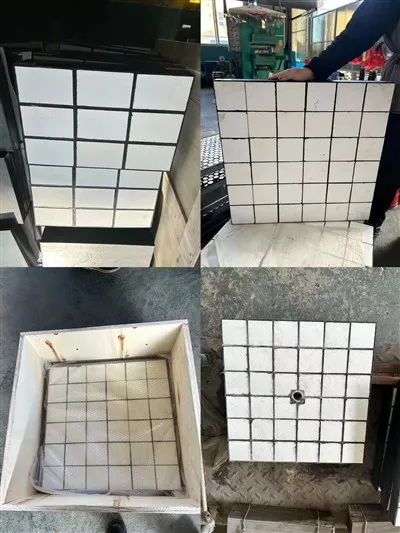
Ceramic Impact Liner Panel is a composite wear panel for bulk material handling areas exposed to direct impact and abrasive flow. The working surface uses dense alumina ceramic, supported by a resilient or rigid backing structure. Ceramic grade, tile thickness, panel dimensions and fixing method can be specified according to material characteristics, impact conditions and installation requirements.
Where Ceramic Impact Liners Are Used
Installed where bulk material falls onto a receiving surface and creates concentrated impact and abrasion.
Used in feed, discharge and transition areas exposed to repeated impact and sliding material flow.
Applied to receiving surfaces where coarse or abrasive solids enter from an elevated position.
Used on defined high-wear areas where modular ceramic panels can be replaced during planned maintenance.
Composite Panel Structure
Alumina Ceramic Layer
The working surface uses alumina ceramic grades from 92% to 99% Al₂O₃. The ceramic grade and thickness are selected according to abrasion level, impact conditions and required mechanical properties.
Resilient Backing
Rubber or polyurethane can be used beneath the ceramic layer to provide compliant support during repeated impact.
Steel Support
Steel-backed construction provides a rigid mounting structure where mechanical attachment or structural reinforcement is required.
Key Product Parameters
|
Parameter |
Technical Value |
|
Alumina content |
≥92% to ≥99% Al₂O₃ |
|
Mohs hardness |
9 |
|
Bulk density |
≥3.63–3.83 g/cm³ |
|
Water absorption |
≤0.01% |
|
Flexural strength |
≥240–300 MPa |
|
Fracture toughness |
4.60–5.70 MPa·m¹/² |
|
Ceramic thickness |
6–50 mm |
|
Common panel sizes |
100 × 100 mm / 150 × 100 mm / 300 × 300 mm |
|
Sintering temperature |
1500–1550°C |
Selecting the Ceramic Grade
92% Alumina
Provides a standard ceramic composition with Mohs hardness of 9, bulk density of at least 3.63 g/cm³ and flexural strength of at least 240 MPa.
95% Alumina
Provides bulk density of at least 3.68 g/cm³ and flexural strength of at least 250 MPa for applications requiring a higher alumina content.
97%–99% Alumina
Provides higher ceramic density and flexural strength, with 99% alumina reaching at least 3.83 g/cm³ bulk density and 300 MPa flexural strength.
Selecting the Backing Structure
Rubber Backing
Provides a resilient interface beneath the ceramic layer for repeated mechanical impact and composite panel construction.
Polyurethane Backing
Provides resilient support with controlled panel geometry for applications requiring a compact composite structure.
Steel Backing
Provides a rigid base where mechanical attachment, structural support or a defined mounting surface is required.
Key Selection Factors
Impact Energy
Drop height, bulk density and feed rate determine the mechanical load applied to the liner surface.
Abrasive Material
Particle hardness, particle size and sliding distance influence ceramic wear.
Ceramic Thickness
Thickness should be selected according to available space, material flow and expected wear exposure.
Panel Geometry
Panel size and shape should follow the chute, hopper or receiving surface to maintain consistent coverage and practical installation.
Quality & Manufacturing Considerations
Powder Preparation
Alumina powder is processed to achieve a controlled particle distribution before forming.
Ceramic Forming
Dry pressing or cold isostatic pressing can be selected according to ceramic geometry and component size.
Controlled Sintering
Ceramic components are sintered at approximately 1500–1550°C to develop the required density and mechanical properties.
Inspection
Chemical composition, hardness, dimensions and visual condition can be checked against the specified product requirements.
Performance Advantages
Hard Ceramic Surface
Alumina ceramic provides Mohs hardness of 9 for abrasive bulk material contact.
Dense Ceramic Body
The ceramic grades provide bulk density from at least 3.63 to 3.83 g/cm³, with water absorption at or below 0.01%.
Impact-Supporting Structure
The ceramic working layer can be combined with resilient or rigid backing according to the mechanical loading and fixing requirements.
Installation Options
Adhesive Installation
Suitable for prepared substrates where the composite panel can be bonded directly to the mounting surface.
Mechanical Fixing
Steel-backed construction can be mechanically attached where the supporting structure requires direct fastening.
Combined Fixing
Adhesive bonding and mechanical retention can be combined where panel geometry and operating conditions require additional retention.
Application Information Required
Provide the material type, particle size, bulk density, drop height, material flow rate, operating temperature and liner location.
Panel dimensions, substrate details, fixing method and required ceramic grade should also be included. Existing drawings or photographs of the wear area can be used to confirm the panel configuration.
FAQ
Q: What is a Ceramic Impact Liner Panel?
A: It is a composite wear panel using an alumina ceramic working surface with a resilient or rigid backing structure for areas exposed to impact and abrasive material flow.
Q: Which alumina grades are available?
A: Alumina grades from 92% to 99% are available. The appropriate grade depends on material characteristics, impact conditions and required ceramic properties.
Q: What ceramic thicknesses are available?
A: Common ceramic thicknesses range from 6 mm to 50 mm. Final thickness depends on the wear zone, installation space and operating conditions.
Q: Can panel dimensions be customized?
A: Yes. Panel dimensions, ceramic thickness, backing construction, surface geometry and fixing arrangement can be specified according to the installation requirements.
Q: Which information is needed for a quotation?
A: Provide panel dimensions, application location, material characteristics, impact conditions, operating temperature, quantity and fixing method. Drawings or photographs can be included for technical review.
Hot Tags: ceramic impact liner panel, China ceramic impact liner panel manufacturers, suppliers, factory, Removable Ceramic Conveyor Linings
You Might Also Like


Send Inquiry