


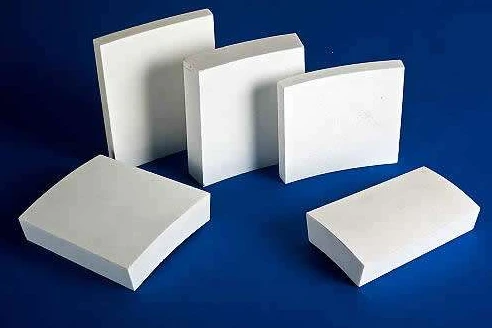
Interlocking Ceramic Impact Liner
Interlocking Ceramic Impact Liner is a modular wear lining designed for transfer chutes, hoppers, bins, and other bulk material handling zones exposed to severe impact and abrasion. High-alumina ceramic tiles form the working surface, combined with rubber, polyurethane, or steel backing selected according to operational impact conditions, structural support requirements, and installation methods.
Product Structure
Ceramic Working Layer
The working surface utilizes alumina ceramic grades ranging from 92% to 99% Al₂O₃, delivering a Mohs hardness of 9. Ceramic thickness is specified based on material flow rate and wear severity.
Interlocking Profile
Trapezoid and specialized geometric profiles mechanically connect adjacent tiles within the lining pattern. This geometry maintains precise tile positioning across sections subjected to continuous material movement.
Composite Backing
Rubber, polyurethane, or steel backing provides energy absorption, structural rigidity, and customized fixing arrangements beneath the ceramic layer.
Why Interlocking Design Matters
Tile Retention
Interlocking edges create positive mechanical engagement between adjacent tiles, securing the planned pattern across high-impact zones and transition areas.
Local Replacement
The modular arrangement enables individual replacement of worn sections. Maintenance quantities follow actual localized wear patterns rather than full-surface overhauls.
Joint Control
Interlocking geometry establishes consistent spatial alignment between neighboring tiles, coordinating tile dimensions with precise joint layouts.
Material Selection
Alumina Grade
Available in 92%, 95%, 97%, and 99% Al₂O₃ options. Grade selection corresponds directly to material abrasiveness, operating temperatures, and required mechanical properties.
Ceramic Thickness
Standard thicknesses range from 6 to 50 mm, chosen according to impact energy, particle size, available clearance, and expected wear life.
Backing Construction
Rubber and polyurethane layers absorb impact shock, while steel backing offers a rigid base for heavy-duty mechanical fastening and structural welded installation.
Technical Specifications
|
Parameter |
Specification |
|
Alumina Content |
92–99% Al₂O₃ |
|
Mohs Hardness |
9 |
|
Bulk Density |
3.64–3.83 g/cm³ |
|
Water Absorption |
≤0.01% |
|
Ceramic Thickness |
6–50 mm |
|
Common Tile Sizes |
50×50 to 200×100 mm |
|
Tile Profile |
Trapezoid / interlocking |
|
Backing Options |
Rubber / polyurethane / steel |
|
Installation |
Bonded / mechanical / composite |
|
Alumina Grade Options |
92% / 95% / 97% / 99% |
Impact Zone Selection
Direct Drop Areas
Material falling vertically creates high concentrated impact forces. Ceramic thickness, tile profile, and backing type must be engineered specifically for these localized zones.
Transfer Areas
Material changes direction at transfer points, generating combined impact and sliding wear. Lining layouts separate primary impact zones from adjacent sliding wear surfaces.
Continuous Sliding Areas
Where material primarily slides across surfaces, ceramic grade and thickness serve as primary selection criteria. Interlocking profiles maintain structural alignment across extended areas.
Typical Applications
Transfer Chutes
Installed at material transfer junctions where bulk solids fall, redirect, or transition between conveying systems.
Feed and Discharge Zones
Applied in equipment sections subjected to repeated material flow and high-frequency impact from incoming solids.
Hoppers and Bins
Fitted to internal container surfaces exposed to continuous loading, bulk impact, and abrasive material sliding.
Bulk Material Handling
Utilized across mining, mineral processing, cement production, aggregate processing, and coal handling facilities handling abrasive bulk solids.
Installation Options
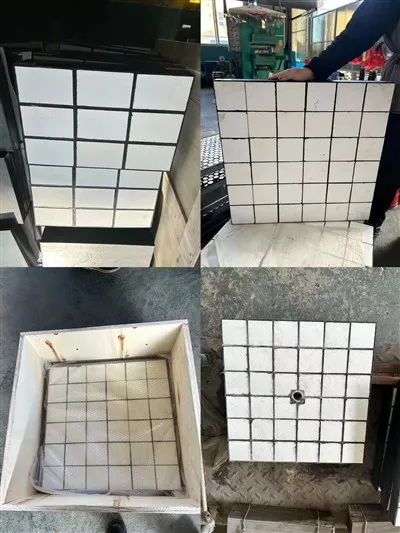
Bonded Installation: Ceramic tiles attach directly to prepared steel surfaces using high-strength structural adhesives where operating conditions permit.
Mechanical Retention: Steel-backed configurations allow bolt-down fastening, rigid structural support, and simplified panel replacement routines.
Composite Installation: Rubber or polyurethane backing integrates with interlocking ceramic tiles to provide resilient shock absorption beneath the wear surface.
Dimensional Customization
Tile Dimensions
Length, width, and thickness are tailored to fit available lining areas and optimize surface coverage.
Interlocking Geometry
Profiles match specific tile arrangements, joint patterns, and curved or flat equipment surface contours.
Equipment Fit
Fabrication drawings determine precise tile layouts, edge details, cutouts, and installation dimensions prior to production.
Quality Control
Ceramic Properties: Inspections verify alumina content, bulk density, surface hardness, water absorption rates, and dimensional tolerances per specification.
Tile Dimensions: Thickness, length, width, and interlocking edge profiles undergo rigorous dimensional verification against agreed standards.
Composite Construction: Backed liners are evaluated for backing dimensions, tile alignment, and peel strength of the composite bonding layer.
How to Specify the Liner
Material Data: Provide handled material characteristics, maximum particle size, volumetric flow rates, and approximate drop heights.
Operating Conditions: Specify operating temperatures, impact locations, material flow angles, and current wear performance to determine optimal ceramic grade and backing.
Equipment Data: Submit equipment drawings, internal lining dimensions, preferred fixing methods, and required quantities to finalize layout designs and production specifications.
Request a Quote: Send equipment drawings or required liner dimensions along with operating conditions. Quotations are customized according to ceramic grade, thickness, interlocking profile, backing construction, overall dimensions, and project quantity.
FAQ
Q: What is an Interlocking Ceramic Impact Liner?
A: It is a modular wear lining utilizing interlocking tile geometries to maintain structural alignment and pattern integrity in severe impact and abrasive material handling environments.
Q: Which alumina grade should be selected?
A: Options range from 92% to 99% Al₂O₃, with selection determined by material abrasiveness, operational intensity, and specific mechanical property requirements.
Q: What thicknesses are available?
A: Standard ceramic thicknesses range from 6 to 50 mm, chosen based on particle size, impact energy, wear life expectations, and available installation clearance.
Q: Can the liner include a backing layer?
A: Yes. Configurations are available with rubber, polyurethane, or steel backing to deliver required impact shock absorption, structural support, and fastening methods.
Q: Can the interlocking liner match equipment dimensions?
A: Yes. Tile dimensions, profiles, and panel layouts are engineered directly from equipment drawings to ensure accurate fit across specific installation areas.
Hot Tags: interlocking ceramic impact liner, China interlocking ceramic impact liner manufacturers, suppliers, factory, Removable Ceramic Conveyor Linings
You Might Also Like



Send Inquiry