


Ceramic Feed Chute Liner
Ceramic Feed Chute Liner protects chute surfaces exposed to abrasive solids, impact and continuous material flow. It is used in feed chutes, loading sections, transfer points and material drop zones for mining, mineral processing, coal handling, cement and bulk material systems. Alumina grade, thickness, shape and fixing method are selected according to the chute geometry and operating conditions.
Product Application
Mining & Mineral Processing: Used in ore feed chutes, crusher discharge areas, transfer chutes and loading sections handling rock, ore and mineral solids.
Coal Handling: Applied to coal feed points, transfer sections and discharge areas where continuous material flow concentrates abrasion on defined chute surfaces.
Cement & Bulk Materials: Used for clinker, limestone, raw materials, aggregates and other abrasive solids moving through inclined or vertical chutes.
Chute Areas Covered
Feed Entry
Protects the first-contact area where incoming material produces concentrated impact and abrasion.
Material Flow Zone
Lines surfaces exposed to continuous sliding, particle contact and material scouring.
Discharge Transition
Protects outlet and direction-change sections where material flow can concentrate wear.
Ceramic Material Selection
92% Alumina: Suitable for general abrasive material handling where the required ceramic properties match the operating conditions.
95% Alumina: Provides a higher density and flexural strength level for more demanding abrasive service.
97% Alumina: Provides increased density and fracture toughness for applications requiring a higher ceramic performance level.
99% Alumina: Used where high alumina content, density and material purity are specified.
Grade selection should consider particle size, material hardness, impact intensity, flow conditions and the location of concentrated wear.
Key Product Features
Dense Alumina Wear Surface: Alumina ceramic provides a Mohs hardness of 9 and a dense working surface for abrasive material contact.
Controlled Section Thickness: Common thicknesses include 6, 10, 12, 15 and 20 mm. Thickness is selected according to wear allowance, impact exposure and available chute clearance.
Chute-Matched Sections: Flat, curved and cut-to-size sections can follow the required chute profile, joint layout and installation area.
Technical Parameters
|
Parameter |
92% Alumina |
95% Alumina |
97% Alumina |
99% Alumina |
|
Al₂O₃ Content |
≥92% |
≥95% |
≥97% |
≥99% |
|
Bulk Density |
≥3.63 g/cm³ |
≥3.68 g/cm³ |
≥3.73 g/cm³ |
≥3.83 g/cm³ |
|
Water Absorption |
≤0.01% |
≤0.01% |
≤0.01% |
≤0.01% |
|
Mohs Hardness |
9 |
9 |
9 |
9 |
|
Fracture Toughness |
4.60 MPa·m¹/² |
4.65 MPa·m¹/² |
5.20 MPa·m¹/² |
5.50 MPa·m¹/² |
|
Flexural Strength |
≥240 MPa |
≥250 MPa |
≥285 MPa |
≥300 MPa |
Shape & Dimension Options
Flat Panels
Used on straight chute walls, side plates and broad flat wear areas.
Curved Sections
Formed to follow chute radii and curved transition surfaces.
Custom Shapes
Tapered, trapezoidal and cut-to-size sections can be prepared for specific joints, clearances and fixing positions.
Installation Configuration
Bonded Lining
Used on prepared steel surfaces where adhesive bonding matches the operating temperature and mechanical conditions.
Mechanical Fixing
Mechanical retention can be specified for sections requiring direct fixing or planned liner replacement.
Composite Backing
Ceramic sections can be combined with a resilient backing layer where additional impact absorption is required.
Quality Control
Material Testing
Alumina content, density, water absorption, hardness and mechanical properties are checked against the specified ceramic grade.
Dimensional Inspection
Length, width, thickness, hole positions and formed sections are checked against the approved dimensions.
Surface Inspection
Ceramic surfaces, edges and corners are inspected before packing to verify the specified condition.
How to Select the Liner
Check Material
Confirm particle size, hardness, moisture, bulk density and material flow characteristics.
Locate Wear
Separate direct-impact areas from sliding-wear areas. Grade and thickness can then be assigned according to each zone.
Check Geometry
Confirm chute width, length, slope, radius, installation clearance, joint layout and fixing locations.
Set Thickness
Select thickness according to wear allowance, impact exposure and available installation space.
Engineering Information Required
Chute Drawing
Provide the chute or liner drawing with dimensions, radii, joint positions and lining areas.
Operating Conditions
State the material handled, particle size, temperature, flow rate and main impact locations.
Installation Details
Include ceramic grade, thickness, fixing method, hole positions and required quantity where available.
Existing liner samples or measured sections can also provide dimensional references.
Packaging & Replacement Planning
Section Identification
Liner sections can be organized according to the chute layout to support installation and replacement sequencing.
Replacement Matching
Existing liner dimensions, drawings or measured chute areas can be used as references for replacement sections.
Handling Protection
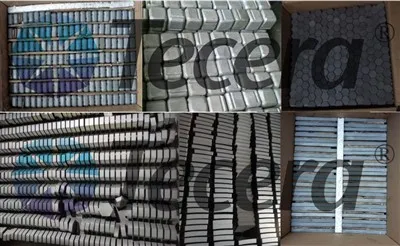
Ceramic sections are packed to limit movement and protect edges during handling and transportation.
Request a Specification Review
Provide the chute drawing, liner dimensions, material characteristics, operating temperature and installation method when requesting a Ceramic Feed Chute Liner. The required ceramic grade, thickness, shape and quantity can then be matched to the specified chute section.
FAQ
Q: Which alumina grade is suitable for a feed chute?
A: 92%, 95%, 97% and 99% alumina grades are available. Selection depends on abrasion, impact exposure, material characteristics and the required ceramic properties.
Q: What thickness is available?
A: Common thicknesses include 6, 10, 12, 15 and 20 mm. Other thicknesses can be specified according to chute clearance and wear requirements.
Q: Can the liner follow a curved chute?
A: Yes. Curved ceramic sections can be produced to follow the required chute radius and installation geometry.
Q: Can existing liner dimensions be used?
A: Yes. Existing liner samples, drawings or measured sections can provide the dimensional basis for replacement sections.
Q: What information is needed for quotation?
A: Provide the chute drawing or dimensions, required quantity, ceramic grade, thickness, material handled, operating temperature and installation method.
Hot Tags: ceramic feed chute liner, China ceramic feed chute liner manufacturers, suppliers, factory, ceramic liner
You Might Also Like




Send Inquiry