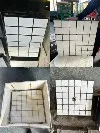
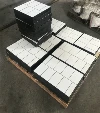
The main categories of wear-resistant ceramics are distinguished by their core components, balancing performance and application scenarios. Details are as follows:
1. Alumina Ceramics (Mainstream in the Market)
With alumina as the core component, they dominate the market due to excellent cost performance. Their Rockwell hardness reaches over HRA85-90, and their wear resistance is dozens of times that of manganese steel. Featuring stable chemical properties and resistance to acids, alkalis, and corrosion, some types can withstand high temperatures up to 1600℃, making them suitable for most conventional wear-resistant scenarios such as mining, cement, and power industries. Common product forms include liners/sheets, pipes, and pipe fittings.

2. Silicon Carbide Ceramics
Their performance is more oriented towards extreme working conditions, with higher hardness and high-temperature resistance than alumina ceramics. They excel in high-abrasion, high-temperature environments, as well as scenarios with strong impact and high-velocity material scouring (e.g., high-end powder transportation, high-temperature flue gas treatment). They are often made into composite products or precision wear-resistant components.

3. Zirconia Ceramics
They combine wear resistance with a certain degree of toughness, and possess additional characteristics such as cleanliness, non-toxicity, and insulation, exceeding traditional wear-resistant requirements. In addition to industrial protection, they can also be extended to high-end fields such as medical devices (joints), automobile engine components, and high-precision electronic components, adapting to high-cleanliness and high-precision working conditions.