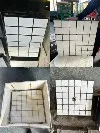
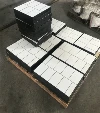
In industrial production, equipment wear has always been a key factor affecting production efficiency and equipment lifespan. With the continuous advancement of material technology, wear-resistant ceramics, as a new type of wear-resistant material, have gradually gained attention. So, what exactly is wear-resistant ceramics? Simply put, it is a ceramic material primarily made from alumina, sintered at high temperatures, and possesses extremely high hardness and wear resistance.

The widespread application of wear-resistant ceramics in industrial fields is primarily attributed to their excellent performance. Firstly, they exhibit extremely high hardness, reaching up to Mohs scale grade 9, second only to diamond, enabling effective resistance to friction and impact from various materials. In industries such as mining machinery, cement equipment, and thermal power generation, where material transportation and crushing processes often subject equipment to wear, the use of wear-resistant ceramics for protection can significantly extend equipment lifespan. Secondly, wear-resistant ceramics possess good chemical stability, resisting acid and alkali corrosion, allowing them to function normally even in highly corrosive environments.

In addition to its applications in industrial equipment protection, wear-resistant ceramics also offer unique advantages in other fields. For instance, in the petrochemical industry, it can be used to protect the inner walls of pipelines, reducing wear and corrosion caused by media. In hydraulic engineering, it can be applied to wear-resistant treatments for components such as gates and turbines, enhancing the anti-wear performance of equipment. Furthermore, wear-resistant ceramics play a significant role in sectors like ceramic machinery and food processing machinery, providing critical support for equipment in these industries