Ceramic Liner Plates: The Protective "Armor" for Efficient and Wear-Resistant Classifiers and Dispersers
In industrial sectors such as cement, mineral powder, and thermal power generation, classifiers and dispersers are core equipment within grinding systems. Their primary mission is to classify, disperse, and separate powdered materials. However, during this process, the internal components of these equipment endure severe erosion and wear from high-concentration, high-hardness materials. Traditional metal wear parts often wear through within months, leading to equipment failure and soaring maintenance costs. The advent of alumina ceramic liner plates, with their exceptional wear resistance, has become the "golden armor" protecting these critical assets.
I. Severe Operating Challenges: Why Classifiers/Dispersers Need Superior Protection?**
Inside classifiers (e.g., cyclone classifiers, O-Sepa separators) and dispersers, materials impact key parts like the inner wall, guide vanes, rotor blades, and scattering discs at very high speeds under the action of high-speed airflow or mechanical force. This wear is primarily three-body abrasive wear, characterized by:
* **High Velocity:** Material flow speeds can reach 20-30 m/s or even higher.
* **High Hardness:** Materials are often cement clinker, slag, coal powder, etc., with high Mohs hardness.
* **High Persistence:** Equipment operates continuously 24/7, meaning wear is constant.
Once the protective layer is worn through, a series of serious consequences follow:
1. **Equipment Damage:** Shell wear-through causes air and material leakage, disrupts the internal airflow field, and drastically reduces classification efficiency.
2. **Unstable Product Quality:** Reduced classification efficiency leads to an inability to control product fineness, affecting final product quality.
3. **Frequent Downtime for Maintenance:** Replacing worn parts requires shutdowns, severely impacting production continuity and increasing labor and maintenance costs.
4. **Soaring Production Costs:** The direct cost of frequently replacing metal wear parts and the indirect losses from downtime are substantial.
II. The Alumina Ceramic Liner Plate Solution: Highlighting the Advantages**
Facing the challenges above, high-alumina ceramic liner plates (typically with 92%-95% Al₂O₃ content) provide an ideal solution. Their application advantages are evident in the following aspects:
**1. Extreme Wear Resistance, Extending Service Life by Over 10 Times**
The wear resistance of ceramic liner plates is more than 170 times greater than that of high-chromium cast iron. In areas suffering the most severe erosion, such as the classifier housing and air inlet volute, ceramic liner plates can extend the service life from a few months to several years, truly aligning with the equipment's major overhaul cycle and significantly reducing lifecycle costs.
**2. Excellent Corrosion Resistance, Adapting to Complex Conditions**
Materials in industrial processes may possess some acidity or alkalinity (e.g., desulfurization ash). Metals are susceptible to corrosion, whereas alumina ceramic is inert and resistant to acid and alkali corrosion, allowing it to perform stably over the long term even in complex conditions.
**3. Smooth Surface, Effectively Reducing Operational Resistance**
Ceramic liner plates have a smooth surface and low friction coefficient. This not only reduces resistance during material conveying, lowering energy consumption, but also effectively prevents the adhesion of fine powder to the surface, maintaining stable internal airflow and thus ensuring the classification precision and efficiency of the classifier.
**4. Stable Structure, Resistant to High Temperatures Without Deformation**
Alumina ceramic can withstand temperatures over 1600°C, fully meeting the operating temperatures inside classifiers and dispersers (typically <200°C). It does not soften or deform like metal at high temperatures, maintaining its original geometry to ensure stable equipment operation.
**5. Flexible Installation and Easy Maintenance**
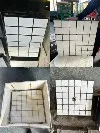
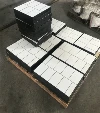
Ceramic liner plates can be pre-formed into various shapes like squares, trapezoids, and arcs to match the equipment's contours. They are installed securely and reliably using special ceramic adhesive bonding, combined with mechanical fixing via bolts if needed. When local wear requires replacement, only the individual worn plate needs to be changed, making maintenance simple and time-efficient.
III. Detailed Key Application Areas**
Within classifiers and dispersers, ceramic liner plates are primarily applied to the following core wear areas:
* **Air Inlet Pipe and Volute:** This is where the dust-laden airflow impacts first, with the highest velocity and most severe erosion, making it the top priority for ceramic liner protection.
* **Cone Section and Inner Walls of the Housing:** Materials slide down the walls under centrifugal force, causing continuous grinding.
* **Rotor Blades and Cage:** As the core rotating component of the classifier, rotor balance is critical. Applying ceramic liner plates effectively protects the blades, preventing imbalance vibration caused by wear.
* **Guide Vanes and Scattering Discs:** These components are in direct contact with materials and require extremely high wear resistance to maintain their precise geometry, ensuring classification accuracy.
* **Discharge Cones and Outlet Air Ducts:** Areas for coarse powder collection and airflow outlet also face significant wear problems.
IV. Economic Benefit Analysis: A Wise, Long-Term Investment**
Although the initial purchase cost of ceramic liner plates is higher than ordinary steel, the comprehensive economic benefits they bring are substantial:
* **Reduced Spare Parts Costs:** Greatly decreases the frequency of wear part replacement and associated inventory.
* **Minimized Downtime Losses:** Long service life translates to fewer unplanned shutdowns, ensuring production capacity.
* **Savings on Maintenance Labor:** Reduces the manpower required for frequent liner replacement.
* **Stable Product Quality:** Consistent equipment performance ensures stable product quality.
**Conclusion**
In the context of modern industrial production striving for high efficiency, energy savings, and low carbon emissions, equipping classifiers and dispersers with the "wear-resistant armor" of alumina ceramic liner plates is no longer just simple equipment maintenance. It is a strategic investment for enhancing core competitiveness and achieving cost reduction and efficiency gains. With their ultra-long service life and stable protective performance, they safeguard the continuous and stable operation of critical equipment, creating sustained value for enterprises.