


Ceramic Cyclone Inlet Liner
Ceramic Cyclone Inlet Liners protect the inlet section of cyclone equipment from abrasive slurry, mineral particles, powder and other solids. The liner covers the defined wear area while maintaining the required inlet profile and internal clearance.
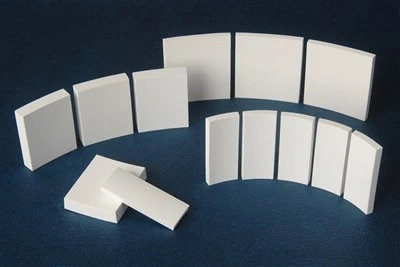
Alumina ceramic sections are available in flat, curved and shaped configurations. Ceramic grade, thickness, section dimensions and installation details are specified from the equipment drawing, existing liner or measured dimensions.
Where Ceramic Cyclone Inlet Liners Are Used
Hydrocyclone Feed Inlets
Applied in slurry classification systems where mineral solids enter the cyclone at high velocity, creating concentrated abrasive impact around the feed entry point.
Dry Cyclone Inlets
Installed in pneumatic and gravity-fed cyclone systems handling abrasive industrial powders, mineral dust and granular particulate materials.
Separation Equipment
Utilized in mineral processing, coal preparation, cement production, and ash handling systems where continuous solid particle flow passes through separation equipment.
Product Structure
Alumina Ceramic Wear Surface
High-density ceramic forms the primary direct contact barrier against sliding and impacting abrasive materials. Standard grades consist of 92%, 95% and 99% aluminum oxide.
Formed Inlet Sections
Individual tiles and blocks are manufactured in flat, curved or custom geometries to match specific inlet profiles, transition radiuses and wear zones.
Supporting Interface
The rear mounting surface, section edges and fastening provisions are engineered to integrate securely with the existing cyclone shell structure.
Key Specifications
|
Parameter |
Typical Specification |
|
Alumina Content |
92% / 95% / 99% Al₂O₃ |
|
Bulk Density |
3.60–3.90 g/cm³ |
|
Ceramic Thickness |
6–25 mm |
|
Rockwell Hardness |
HRA 82–90 |
|
Shape |
Flat / Curved / Shaped |
|
Section Dimensions |
Produced per drawing specification |
|
Installation |
Bonded / Mechanical / Specified method |
|
Surface Finish |
Smooth ceramic surface |
How to Select the Inlet Liner
Match the Inlet Geometry
Define precise inlet length, width, diameter, entry angle, radius and internal clearance to determine optimal section layout and tile profiles.
Select Ceramic Thickness
Choose liner thickness based on particle size, solids concentration, flow velocity, and available installation space within the housing.
Choose the Ceramic Grade
Select between 92%, 95% and 99% alumina formulations depending on the abrasive characteristics of the handled material and operating severity.
Wear Areas to Review
Feed Entry Zone
The initial impact zone receives direct particle collision and high-velocity sliding contact, requiring full tile coverage matching actual wear patterns.
Curved Transition
Rapid changes in flow direction concentrate abrasive forces along specific internal radiuses, requiring precision-formed curved ceramic segments.
Downstream Flow Path
The connection point where the inlet liner meets the main cyclone body requires aligned joints to ensure smooth transition into adjacent wall linings.
Manufacturing and Dimensional Control
Ceramic Forming: Components are pressed and fired to exact length, width, radius and profile dimensions to match specific equipment inlet geometries.
Thickness Control: Dimensional verification is performed against approved engineering drawings and technical specifications prior to final assembly.
Edge and Interface Fit: Joint positions and section edges are controlled to maintain internal flow profiles and deliver uniform installation interfaces.
Information Required for Quotation
Equipment Dimensions: Provide nominal cyclone diameter, inlet cross-section dimensions, entry angles, transition radius and internal clearance measurements.
Drawing or Sample: Submit a dimensioned engineering drawing, existing technical drawing, worn liner sample, or physical template for dimensional reference.
Operating Conditions: Specify conveyed material type, particle size distribution, solids concentration, fluid velocity, operating temperature and system pressure.
Application Compatibility
Ceramic Cyclone Inlet Liners are suited for industrial cyclone systems where solid particles generate concentrated wear around feed entry sections. Typical installations include mineral processing plants, coal preparation facilities, cement production lines, and dry powder handling systems. Selecting appropriate ceramic grades and thicknesses ensures reliable service life across diverse operating conditions.
FAQ
Q: What information is needed to make a Ceramic Cyclone Inlet Liner?
A: Provide equipment drawings, exact inlet dimensions, transition radius, required thickness, and installation method preferences.
Q: Can the inlet liner be made for an existing cyclone?
A: Yes. Sections can be custom-manufactured from existing equipment dimensions, field drawings, or physical samples.
Q: Which alumina grade should be selected?
A: Selection depends on material abrasiveness, particle size, flow velocity, and required wear resistance among 92%, 95% and 99% grades.
Q: How is ceramic thickness determined?
A: Thickness is calculated based on particle impact energy, solids loading, flow velocity, and available installation clearance.
Q: Can the liner follow a curved inlet surface?
A: Yes. Precision-formed curved ceramic segments match specified inlet radiuses and transition geometries.
Q: What should be included in an inquiry?
A: Include equipment drawings or inlet dimensions, preferred ceramic grade, thickness, quantity, and known operating conditions.
Hot Tags: ceramic cyclone inlet liner, China ceramic cyclone inlet liner manufacturers, suppliers, factory, ceramic liner
You Might Also Like


Send Inquiry