


Ceramic Cyclone Cone Liner
Ceramic Cyclone Cone Liners protect the tapered internal section of cyclone equipment from abrasive slurry, mineral particles, coal fines, ash and other solids. The liner follows the cone geometry to protect the internal wall while maintaining the required flow passage.
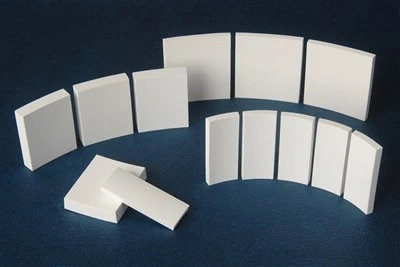
Alumina ceramic sections are available in curved and shaped forms. Ceramic grade, thickness, section dimensions, cone angle and joint layout are specified from the equipment drawing, existing liner or measured dimensions.
Where Ceramic Cyclone Cone Liners Are Used
Used in cyclone circuits handling abrasive mineral slurry and continuously circulating solids.
Applied to cone sections exposed to coal fines, mineral matter and dense slurry flow.
Suitable for hydrocyclone service where abrasive particles move along the tapered internal surface.
Used in abrasive separation systems where the cone wall and internal flow profile require wear protection.
Cone Liner Construction
Alumina Ceramic
The wear surface uses alumina ceramic with Al₂O₃ grades from 92% to 99%.
Curved Sections
Curved sections follow the cone radius and provide a continuous ceramic surface along the tapered area.
Section Layout
Individual ceramic sections are arranged according to cone geometry, wear location and installation requirements.
Material Selection
92% Alumina
Suitable for general abrasive service where balanced ceramic properties are required.
95% Alumina
Suitable for higher abrasion loads where increased alumina content and ceramic density are required.
97%–99% Alumina
Used where higher density, hardness and material purity are required for the operating conditions.
|
Material Grade |
Al₂O₃ |
Bulk Density |
Water Absorption |
Mohs Hardness |
Flexural Strength |
|
92% Alumina |
≥92% |
≥3.63 g/cm³ |
≤0.01% |
9 |
≥220 MPa |
|
95% Alumina |
≥95% |
≥3.68 g/cm³ |
≤0.01% |
9 |
≥250 MPa |
|
97% Alumina |
≥97% |
≥3.73 g/cm³ |
≤0.01% |
9 |
≥285 MPa |
|
99% Alumina |
≥99% |
≥3.83 g/cm³ |
≤0.01% |
9 |
≥330 MPa |
Key Specifications
|
Parameter |
Specification |
|
Alumina Content |
92%–99% Al₂O₃ |
|
Bulk Density |
3.63–3.83 g/cm³ |
|
Water Absorption |
≤0.01% |
|
Mohs Hardness |
9 |
|
Flexural Strength |
≥220–330 MPa |
|
Section Thickness |
According to cone design |
|
Section Shape |
Curved / Shaped / Tapered |
|
Cone Diameter |
According to drawing |
|
Cone Angle |
According to drawing |
How to Select the Liner
Match the Cone Profile
Cone diameter, cone angle, radius and section length determine the required ceramic geometry.
Set the Thickness
Liner thickness is selected from the wear condition, available internal clearance and existing liner structure.
Match the Material
Alumina grade is selected from particle characteristics, solids concentration, flow conditions and expected abrasion level.
Critical Dimensions for RFQ
Cyclone Geometry
Provide cone diameter, cone length, cone angle and internal profile dimensions.
Liner Dimensions
Provide existing liner thickness, section length, width, radius and quantity when replacement sections are required.
Operating Data
Provide material type, particle size, solids concentration, flow rate and operating temperature when available.
Replacement and Retrofit
Existing Cone
Replacement sections can be matched to an existing liner, measured cone or approved equipment drawing.
Defined Wear Areas
Ceramic sections can be arranged around specific wear zones according to the actual cone wear pattern.
Internal Clearance
Installed thickness and joint positions are checked against the required internal flow passage.
Manufacturing and Quality Checks
Curved and shaped sections are formed according to the specified cone geometry and dimensions.
Controlled sintering develops the required density and ceramic structure for the selected alumina grade.
Section thickness, length, width, radius and profile dimensions are checked against the approved drawing.
Ceramic surfaces and edges are inspected for visible cracks, chips and dimensional irregularities before packing.
What Should Be Confirmed Before Ordering
Drawing or Sample
A cyclone drawing, existing liner or measured dimensions provides the reference for section geometry.
Ceramic Grade
Confirm the required Al₂O₃ grade and corresponding material specification.
Installation Method
Confirm the bonding or fixing method, joint arrangement and available installation clearance.
Section Quantity
Confirm the complete cone layout and the required number of ceramic sections.
Typical Application Conditions
Abrasive Slurry
Mineral particles carried in slurry create continuous contact with the ceramic surface.
Fine Solids
Fine particles moving at operating velocity can produce sustained sliding abrasion along the cone wall.
Concentrated Wear Zones
Areas exposed to higher particle loading can receive section geometry and thickness matched to the measured wear pattern.
Inquiry Information
For technical review, provide the cyclone drawing or existing liner dimensions together with ceramic grade, thickness, quantity and operating conditions. Photos of the existing liner and cone interior can support dimensional review when drawings are unavailable.
The required specification can then be confirmed for cone geometry, ceramic grade, section dimensions and installation arrangement.
FAQ
Q: Can the cone liner match an existing cyclone?
A: Yes. Ceramic sections can be specified from an equipment drawing, existing liner, sample or measured cone dimensions.
Q: What alumina grades are available?
A: Alumina grades from 92% to 99% Al₂O₃ are available, with material selection based on the operating conditions and required ceramic properties.
Q: Can the liner thickness be customized?
A: Yes. Section thickness is specified according to cone geometry, wear conditions, internal clearance and installation requirements.
Q: What information is needed for quotation?
A: Provide cone diameter, cone angle, cone length, liner thickness, section dimensions, quantity and available operating data.
Q: Can individual cone sections be replaced?
A: Yes. A sectioned liner arrangement allows defined ceramic sections to be replaced according to the cone layout and maintenance requirements.
Hot Tags: ceramic cyclone cone liner, China ceramic cyclone cone liner manufacturers, suppliers, factory, ceramic liner
You Might Also Like



Send Inquiry