


Ceramic-Lined Elbow
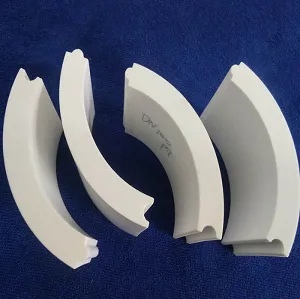
Ceramic lined elbows use an alumina ceramic lining inside a steel pipe elbow to protect the internal flow path from abrasive material. They are used at pipeline direction changes where particle impact and sliding wear are concentrated. Pipe size, bend angle, centerline radius, ceramic grade and lining thickness can be specified from the pipeline drawing and operating conditions.
Key Benefits
Abrasion Protection
Alumina ceramic provides a hard internal wear surface for abrasive materials. Ceramic grades from 92% to 99% alumina allow the lining specification to be matched to the application.
Defined Internal Bore
The ceramic lining is arranged around the elbow geometry to maintain the required finished inside diameter. Thickness is selected together with the pipe size and operating duty.
Steel-Ceramic Construction
The steel body provides the structural shape of the elbow while the alumina ceramic forms the internal wear surface. The configuration can be adapted to different pipe dimensions and connection requirements.
Ceramic Grade Selection
92% Alumina
Suitable for general abrasive conveying where a standard alumina ceramic grade meets the operating conditions.
95% Alumina
Provides higher density than 92% alumina and is suitable for more demanding abrasive service.
97% and 99% Alumina
Higher alumina grades provide greater ceramic density and are selected when the application requires a denser wear surface.
Typical Specifications
|
Parameter |
Typical Value |
|
Ceramic Material |
Alumina Ceramic |
|
Alumina Content |
92%, 95%, 97%, 99% |
|
Mohs Hardness |
9 |
|
Bulk Density |
3.60–3.83 g/cm³ |
|
Water Absorption |
≤0.01% |
|
Ceramic Thickness |
6–25 mm |
|
Standard Tile Thickness |
6, 10, 12, 15, 20, 25 mm |
|
Bend Angle |
22.5°, 30°, 45°, 90°, custom |
|
Centerline Radius |
1.5D–5D, custom |
How to Select the Right Elbow
Confirm Pipe Size
Provide the pipe nominal size or required finished inside diameter. Ceramic thickness must be included when calculating the final bore.
Define Bend Geometry
Specify the bend angle and centerline radius. These dimensions determine the elbow profile and ceramic section arrangement.
Select Lining Thickness
Typical ceramic thickness is 6–25 mm. Selection should consider particle hardness, particle size, conveying velocity and operating duty.
Check Connections
Flange dimensions, welded ends, tangent length and orientation should match the pipeline drawing or existing installation.
Application Conditions That Matter
Material Characteristics
Particle hardness, particle size and solids concentration affect the wear load on the elbow. These details help determine the ceramic grade and lining configuration.
Conveying Velocity
Material velocity affects impact and sliding abrasion through the bend. Actual operating velocity should be provided for specification review.
Temperature
Continuous and peak temperatures should be stated with the application data. Temperature can affect the steel body, bonding system and complete lining construction.
Ceramic Manufacturing
Powder Processing: Alumina powder is processed to obtain a controlled material composition and particle distribution before forming.
Ceramic Forming: Ceramic sections are formed according to their required geometry. Isostatic pressing can be used for larger curved ceramic sections where controlled density is required.
Sintering: Formed ceramic components are sintered at controlled high temperatures to develop the required alumina structure and density.
Dimensional Finishing: Ceramic sections are shaped and finished to match the elbow radius, internal diameter and specified lining thickness.
Quality Control
Ceramic Properties: Alumina content, bulk density, hardness and water absorption can be checked against the applicable material specification.
Dimensional Inspection: Ceramic thickness, internal diameter, bend angle, centerline radius and connection dimensions are checked against the approved drawing.
Surface Inspection: Ceramic sections are inspected for visible cracks, edge damage and dimensional conformity before assembly.
Configuration for Pipeline Projects
Ceramic lined elbows can be specified together with straight ceramic lined pipes, tees, reducers and other fittings. Matching the ceramic grade and lining thickness across connected sections helps maintain a consistent internal wear specification.
For replacement or project work, provide the pipe diameter, bend angle, centerline radius, connection dimensions, conveyed material, particle size, conveying velocity, operating temperature and required lining thickness.
Request a Ceramic Lined Elbow
Provide the pipe size, bend angle, centerline radius, connection type, ceramic grade, lining thickness and operating conditions when requesting a quotation. A dimensional drawing is preferred for custom elbows because it allows the pipe geometry, connection details and ceramic arrangement to be confirmed before production.
FAQ
Q: What ceramic grades are available?
A: 92%, 95%, 97% and 99% alumina ceramic grades are available. The appropriate grade depends on material characteristics and operating conditions.
Q: What bend angles are available?
A: Common configurations include 22.5°, 30°, 45° and 90°. Other angles can be specified according to the pipeline geometry.
Q: What ceramic thickness is available?
A: Typical ceramic thicknesses range from 6 to 25 mm, with standard thickness options including 6, 10, 12, 15, 20 and 25 mm.
Q: Can the elbow be produced from an existing drawing?
A: Yes. Pipe size, bend angle, centerline radius, connection dimensions and lining arrangement can be specified from an engineering drawing.
Q: What information is needed for quotation?
A: Provide pipe size, elbow angle, radius, connection type, ceramic grade, lining thickness, conveyed material, conveying velocity and operating temperature. A drawing helps confirm the final configuration.
Hot Tags: ceramic-lined elbow, China ceramic-lined elbow manufacturers, suppliers, factory, ceramic liner
Previous
Ceramic-Lined Pipe BendNext
No InformationYou Might Also Like




Send Inquiry