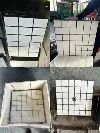
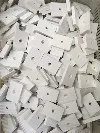
In heavy industries battling severe abrasion, high-velocity material impact, and frequent liner failure, hexagon ceramic liners have emerged as a revolutionary upgrade, outperforming traditional rectangular liners with interlocking honeycomb design and unmatched wear resistance.
Crafted from high-purity alumina (92%–95% Al₂O₃) or zirconia ceramics, hexagon ceramic liners feature a precision-engineered hexagonal shape that interlocks seamlessly, eliminating the "cross-joint weakness" of square tiles where materials infiltrate and dislodge liners under high-speed flow. With exceptional hardness (HRA 80–90) and wear resistance 5–10 times greater than manganese steel, these liners withstand extreme conditions: temperatures up to 350°C, particle velocities over 20 m/s, and impact forces exceeding 50 J/cm².
The interlocking structure delivers transformative performance benefits. It provides 100% surface coverage with no gaps, preventing material penetration and substrate corrosion. The honeycomb distribution disperses stress evenly, reducing tile chipping and delamination by 40% compared to rectangular liners. Additionally, their lightweight design (3.6 g/cm³, half the density of steel) minimizes equipment load, while customizable sizes (25×25mm to 500×500mm) adapt to curved surfaces, chutes, hoppers, and cyclones.
Industry adoption is accelerating across key sectors. In mining, hexagon liners protect ore chutes and ball mills, extending service life from 6 months to 5 years and cutting maintenance costs by 50%. In cement plants, they line clinker conveyors and raw mill cyclones, withstanding high-temperature clinker abrasion. In thermal power plants, they excel in coal ash pipelines and pulverized coal systems, resisting high-velocity ash erosion and reducing unplanned downtime. They also serve steel mills, port bulk handling, and new energy material processing, where durability and reliability are critical.
Manufacturers drive innovation with hybrid designs, embedding hexagon tiles into rubber or steel substrates via vulcanization or high-strength bonding, combining ceramic's wear resistance with rubber's shock absorption. The global hexagon ceramic liner market is projected to grow at a 7.2% CAGR through 2033, fueled by demand for low-maintenance, long-lasting wear solutions.
"Hexagon ceramic liners solve the biggest flaw of traditional liners: joint failure under extreme abrasion," said a senior materials engineer at a leading industrial ceramics manufacturer. "Their interlocking design isn't just a shape change-it's a structural upgrade that delivers unrivaled protection, longer service life, and lower total cost of ownership."
As heavy industries prioritize efficiency and sustainability, hexagon ceramic liners stand poised to become the new standard for wear protection. With ongoing advancements in material formulation and custom engineering, they will continue to expand into new applications, driving productivity and operational resilience across the global industrial supply chain.