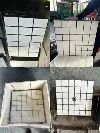
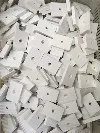
As mining, thermal power, cement and chemical industries face heavy abrasion, high-speed particle erosion and chemical corrosion inside pipelines, ceramic tube liners have become an indispensable inner protective solution, greatly extending service life of conveying pipelines and cutting operational costs.
Ceramic tube liners are mainly made of high-purity 92%-95% alumina ceramics or zirconia-toughened alumina ceramics through high-temperature sintering. They feature ultra-high hardness (HRA 85-92), low friction coefficient, excellent acid-alkali resistance and thermal stability. Compared with ordinary steel pipes, their wear-resistant performance is 10-20 times higher, effectively solving pipeline leakage, perforation and frequent replacement problems caused by long-term transportation of coal ash, mineral powder, cement raw meal and chemical slurry.
With a seamless tubular structure, ceramic tube liners can be closely compounded with outer steel pipes through integral casting or epoxy bonding. The composite structure combines the high toughness of steel and the wear resistance of ceramics, adapting to high-pressure, high-flow and high-impact working conditions. It also reduces material adhesion and pipeline blockage, improving conveying efficiency by 15-25%.
In global industrial markets, the demand for ceramic tube liners keeps rising steadily. They are widely applied in coal ash discharge pipelines of power plants, ore slurry pipelines of mines, raw material conveying pipelines of cement plants, and corrosive medium pipelines of fine chemical industries. Many large-scale mining groups and power enterprises have replaced traditional steel pipelines with ceramic-lined steel pipes, cutting annual maintenance costs by more than 45%.
Manufacturers are continuously optimizing product structures, developing ultra-long integral ceramic liners and curved elbow-type ceramic liners to meet complex pipeline layout needs. Custom-made inner diameter and thickness solutions are provided for different working conditions, realizing precise matching of wear resistance and impact resistance.
"Ceramic tube liners solve the core pain point of pipeline wear failure in bulk-material transportation," said a senior industrial ceramics engineer. "It is a cost-effective long-term investment for enterprises, balancing wear resistance, safety and economy perfectly."
With the global industrial sector pursuing high efficiency and low carbon, ceramic tube liners will expand into more emerging fields such as new-energy material transportation and solid-waste treatment, becoming the mainstream protective liner for industrial pipelines worldwide.