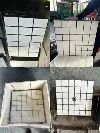
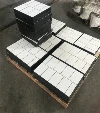
Conveyor pulley slippage, premature rubber lagging abrasion and frequent belt damage have long plagued bulk material industries. Now, ceramic lagging tiles embedded into rubber backing sheets become the industry-standard upgrade to resolve these persistent operating troubles.
Manufactured from high-purity 92%–95% alumina powder sintered at ultra-high temperature, ceramic lagging tiles adopt unique raised dimple textures to maximize friction coefficient. Compared with ordinary rubber lagging, they deliver 2–3 times stronger gripping force even under wet, muddy, dusty or icy working conditions, effectively stopping belt slip and reducing unnecessary belt tension that accelerates wear. Their Mohs 9 ultra-hard surface offers wear resistance 3–5 times superior to rubber lagging, greatly extending the service cycle of pulley lining assemblies.
These modular square ceramic lagging tiles feature two mature installation modes: pre-vulcanized rubber-ceramic composite sheets for cold bonding on pulleys, and single loose tiles for customized on-site paving. FRAS flame-retardant anti-static rubber backing is optional for underground mining and high-temperature power plant environments, complying with global industrial safety standards. When partial tiles wear out, maintenance crews only replace damaged pieces instead of stripping the entire lagging layer, slashing labor costs and unplanned production halt time by over 40%.
Global market statistics show the ceramic pulley lagging market reached USD 899 million in 2025, with a steady 4.5% CAGR forecast through 2032, driven by mining, cement, thermal power, port bulk handling and solid waste recycling sectors. Mining operators widely fit lagging tiles on drive, tail and snub pulleys for ore conveying; cement plants apply them on clinker transport conveyor systems; power stations rely on the product for coal ash and pulverized coal delivery lines. Field feedback proves clients cut annual pulley maintenance expenditure remarkably after switching from pure rubber lagging.
Local industrial ceramic manufacturers provide customized lagging tile sizes, thicknesses and surface designs (smooth or dimpled) according to client pulley drawings. All finished tiles pass full batch testing with complete material traceability and meet international ISO quality certifications. Automated production lines maintain robust monthly output to support large global orders with stable fast delivery, alongside one-stop customized conveyor wear protection schemes.
"Traditional rubber lagging fails quickly in abrasive, humid environments and cannot avoid belt slip," said a senior industrial ceramics engineer. "Ceramic lagging tiles perfectly combine ultra-high friction and long wear life, lowering the total operating cost of the whole conveyor system for bulk material enterprises."
With global heavy industries pursuing higher conveying efficiency and lower maintenance costs, ceramic lagging tiles will gain broader adoption in new energy lithium ore processing and large-scale logistics terminals, retaining steady growth in the global conveyor accessory market over the next decade.