


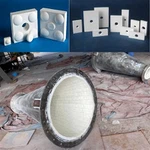


Alumina Ceramic Cube
product

What It Is
An alumina ceramic cube is not a complex product. It is a block of high‑density alumina, shaped as a square or rectangle, used to line the inside of industrial equipment. You find them in chutes, hoppers, bins, transfer points, cyclones, and feeders. Anywhere that bulk material moves – ore, coal, cement, sinter, ash – the steel underneath wears out. The cube takes the punishment instead.
Where It Goes
The core advantage is simple. A steel chute might last six months. A ceramic cube liner, properly installed, can last three to five years. For a plant operator, that means fewer shutdowns, less emergency welding, and a maintenance schedule they can plan around. For a wholesale buyer, it means repeat orders and customers who stay because the product actually works.


We have been making these cubes for over twenty‑five years. Not just the standard 50×50 mm blocks, but more than two thousand variations – tapered cubes for curved chutes, interlocking designs for vibrating feeders, cubes with spherical bumps for high‑impact zones, and small mosaic cubes for tight radii. If a customer sends a drawing, we can make a die and produce the shape.
Quick Look at Performance
Hardness
Mohs 9. That is one step below diamond. Quartz, which is the main abrasive in many ores and in coal, is Mohs 7. Quartz cannot scratch the cube. Steel is about Mohs 5. That is why steel wears out fast.
Density
Above 3.63 g/cm³ for our standard grades, up to 3.85 g/cm³ for the highest purity. Low porosity means water absorption below 0.01%. No liquid gets in. No freeze‑thaw cracking. No chemical attack from acidic slurry.
Toughness
Standard grades have fracture toughness around 4.6 MPa·m¹/². Our TW92S and TW95S grades reach 5.7 and 4.7 respectively. That matters where large rocks drop from height – the cube absorbs the impact without cracking.
Production Process

Raw Material Processing
The raw material is calcined alumina powder. For grades above 95%, we import the powder to keep iron and sodium very low. Some customers need that purity – for example, lithium battery material plants where even 10 ppm of iron ruins the product.
The powder goes through a wet mill to achieve a uniform particle size, then a spray dryer turns it into free‑flowing granules. Forming depends on the cube size. Small cubes (up to 50 mm) are dry‑pressed. Larger cubes use cold isostatic pressing. Isostatic pressing applies pressure from all directions, so the density is the same at the center as at the surface. A dry‑pressed cube can have a less dense middle, which wears faster and leads to uneven surfaces. We use isostatic pressing for all cubes above 50 mm – a step many competitors skip to save money.
Cubes dry
After pressing, the cubes dry slowly. Rushing the drying creates micro‑cracks. Those cracks are invisible at first, but they grow under impact. The dried cubes then go into a tunnel kiln at 1500–1550 °C. At that temperature, the alumina grains fuse. Bulk density reaches the target, and water absorption drops below 0.01%.


Quality control
Quality control happens batch by batch. Chemical composition is verified with X‑ray fluorescence. Hardness is tested with a Vickers indenter. We also check random samples for crush strength and dimensional accuracy. Cubes that are chipped, cracked, or out of tolerance are rejected. Roughly 2–3% of production never leaves the factory.
Shape Range and Custom Tooling
What makes us different from many suppliers is the range of shapes. We maintain dies for over two thousand different cube configurations – including tapered cubes, interlocking blocks, cubes with spherical bulges, fan‑shaped tiles with holes, and H‑series concavex designs. If a customer needs a custom shape, we can make a new die. Lead time is four to six weeks.

Products Description
Company Advantages
We have been in this business for more than 25 years. Not as a trader – as a manufacturer. Our plant covers over 30,000 square metres and employs 300 people worldwide. Three automatic production lines give us an annual capacity of 30,000 metric tons of wear‑resistant ceramics.
We hold ISO 9001 and ISO 14001 certifications. Our quality control system checks every batch at least five times before shipping. Advanced production equipment keeps tolerances tight and output consistent.
Our engineering team works directly with wholesale buyers. If a customer has an unusual wear problem – a chute with a strange angle, a feeder that shakes violently, a pipe that needs a specific curve – we can design a custom cube. Drawings in DWG, PDF, or STEP format are accepted.
ISO 45001

ISO 9001

ISO 14001

Technical Data (Typical Values)
The table below shows typical properties for our main grades. Batch certificates are available for every shipment.
| Grade | Al₂O₃ (%) | Vickers Hardness (HV50) | Water Absorption (%) | Fracture Toughness (MPa·m¹/²) | Bulk Density (g/cm³) |
|---|---|---|---|---|---|
| TW92 | ≥92 | ≥970 | ≤0.01 | 4.60 | ≥3.63 |
| TW92S | ≥92 | ≥1100 | ≤0.01 | 5.70 | ≥3.63 |
| TW95 | ≥95 | ≥975 | ≤0.01 | 4.65 | ≥3.65 |
| TW95S | ≥95 | ≥1250 | ≤0.01 | 4.70 | ≥3.68 |
| TW97 | ≥97 | ≥1300 | ≤0.01 | 5.20 | ≥3.80 |
| TW99 | ≥99 | ≥1450 | ≤0.01 | 5.50 | ≥3.85 |
TW92S and TW95S are higher‑toughness grades for impact‑prone areas.
Common cube sizes (length × width, thickness variable):
23×23 mm (with spherical bulge)
35.7×35.7 mm (cube or block)
38×38 mm, 40×40 mm, 50×50 mm (plain or locked)
100×100 mm, 150×100 mm, 300×300 mm
Tapered cubes: 21.3/15.8×21.3/15.8 mm, 42.5/31.6×42.5/31.6 mm, etc.
Mosaic cubes: 12×12 mm, 17.5×17.5 mm, 20×20 mm, 25×25 mm
Swallow‑tail (A‑ST) and concavex (H‑series) designs for mechanical interlocking
More than two thousand sizes and shapes are available. If you do not see what you need, ask. We probably have the die.


Why Your Customers Will Benefit
Because the cube is made from high‑density alumina and sintered at the correct temperature, it wears slowly and evenly. A steel liner in a coal chute can lose 5 mm of thickness in six months. A Tecera TW95 cube loses less than 0.1 mm over the same period. That is not a laboratory number – it comes from a prep plant in West Virginia that switched from steel to our cubes. The steel liners needed replacement twice a year. The first set of cubes lasted 42 months. For your customer, that means three fewer shutdowns over three years. Each shutdown costs labour, lost production, and the risk of accidents. When you supply a product that eliminates those costs, your customer will not look elsewhere.
Because the high‑toughness grades (TW92S, TW95S) have significantly higher fracture toughness, they absorb impact without cracking. In a crusher discharge chute, rocks can weigh 50 kg and drop from two metres. Standard alumina tiles often crack within weeks. The tougher grades survive for years. For a mine processing 10,000 tons per day, avoiding a four‑hour emergency repair saves roughly $30,000 in lost production (depending on the commodity). That saving alone pays for the entire lining many times over. When you can show your customer this math, the higher price of the tougher grade becomes an easy sell.
Because interlocking and tapered designs eliminate straight‑line gaps, the lining does not develop erosion channels. A standard square tile leaves a grid of seams. Abrasive particles find those seams and carve grooves. Once a groove reaches the steel, the tile loses support and falls out. Interlocking cubes force the seams to stagger, so no continuous path exists. This is not a minor detail – it can double or triple the life of the lining in high‑velocity applications. For a cement plant conveying clinker at 20 m/s, that difference is the line between a two‑year lining and a six‑month lining. Your customer will notice.
Because water absorption is below 0.01%, the cubes do not absorb process liquids. In a coal prep plant, the slurry is often acidic. A porous tile would absorb that acid and gradually weaken. In a northern power plant, winter temperatures drop below −20 °C. A tile that absorbs moisture will freeze and crack. Our cubes have near‑zero porosity, so they survive both chemical attack and freeze‑thaw cycles. One customer in Inner Mongolia has used our cubes for five winters with no freeze‑related failures. For you, that means fewer climate‑related complaints and a product you can sell anywhere.


Shipping and Packaging
We pack cubes in carton boxes or PP bags, then palletize and stretch‑wrap. Each 20‑foot container holds 20–25 metric tons net weight. Wooden pallets are fumigated.
We ship on FOB, CIF, EXW, CPT, and FCA terms. Our logistics partners have helped us export to more than 40 countries. We know the paperwork, the customs requirements, and the best routes.
Request a Quote
If you are a wholesale buyer, send us the following: cube dimensions (or a drawing), the grade you need (TW92, TW95, TW97, TW99, or the high‑toughness versions), the material your customer is handling, and the estimated annual volume. We will reply with a price and lead time within two business days.
Free samples are available for destructive testing. We would rather you break a cube in your workshop than discover a problem on site. Lead time for standard sizes is two to three weeks. Custom shapes require four to six weeks.
Contact us through the form below.
Keywords: alumina ceramic cube, square ceramic liner, interlock ceramic cube, ceramic wear tile
Hot Tags: alumina ceramic cube, China alumina ceramic cube manufacturers, suppliers, factory
Previous
No InformationYou Might Also Like


Send Inquiry