


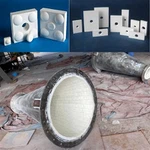

CERAMIC WEAR COMPOUND
Ceramic wear compound is a two-part, epoxy-based material filled with ceramic beads or powder. You use it to apply a protective armor layer onto industrial equipment that is being gradually worn down by the impact of abrasive materials like sand, ore, or slurry.

Where to apply ceramic wear compound ?
Material Handling and Transfer Points: This is the most common application. You use it to line chutes, hoppers, bins, and bunkers where bulk materials slide or fall. It also protects transition points, elbows, and cyclones from the abrasive impact of materials changing direction.
Pumping and Slurry Systems: The compound is excellent for protecting equipment handling abrasive slurries (liquid mixed with solid particles). This includes slurry pumps, pump casings, and impellers, as well as dredge pump liners and ash handling pipes.
Material Processing Equipment: You can rebuild and protect the surfaces of screw conveyors and augers, vibrating feeders and screens, crushers, breakers, and pulverizers.
Air and Gas Handling Systems: It's also effective for equipment handling dust-laden air, such as fan blades and housings and dust collectors and exhausters

When to Choose Ceramic Epoxy Compound?
You should consider using a ceramic wear compound in these situations:
Preventive Maintenance: You want to apply a protective lining to new equipment in high-wear zones to prevent failure before it starts.
Repairing Worn Equipment: Your existing equipment has grooves, gouges, or holes caused by erosion. You can "cold cast" the compound to rebuild the original profile.
Extending Part Lifespan: Your replacement parts (like pump liners or chute sections) are failing too quickly, and you need a way to make them last longer.
Avoiding Hot Work: You need to make a repair in a hazardous environment (like a mine or chemical plant) where welding is dangerous or requires a lengthy permitting process.
How to Apply It
Surface Preparation (Critical): This is the most important step. The surface must be clean, dry, and abraded. You need to roughen the metal, typically by grit-blasting, to give the epoxy something to grip onto.
Mixing: The compound comes in two parts (resin and hardener). You must mix them thoroughly in the exact ratio specified until the color is uniform.
Application: Use a trowel or putty knife to apply the compound. Force the first layer firmly into the prepared surface to avoid trapping air, then build up to the required thickness.
Curing: Allow the compound to cure. Many formulas achieve a "functional cure" in 4 to 8 hours, allowing you to return equipment to service within a single shift
What is The advantage of the ceramic wear compound
Ceramic wear compound provides a combination of protection, application, and cost advantages that traditional materials like steel or weld overlays simply cannot match. Its primary strength lies in shielding equipment from abrasive wear, the gradual wearing away of material caused by the friction of particles like sand, ore, or slurry .
The core advantages can be broken down into four key areas:
1. Superior Protection in Harsh Environments
This is the main reason to choose ceramic wear compounds. They are formulated to handle the toughest industrial conditions.
Excellent Wear and Abrasion Resistance: The compound is filled with hard ceramic beads (like alumina), creating a durable surface that significantly outlasts steel and traditional epoxy products . It provides excellent protection against both sliding abrasion (material moving across the surface) and impact from falling or striking particles .
Corrosion and Chemical Resistance: In addition to physical wear, the epoxy matrix is chemically resistant, protecting the underlying metal from corrosion, pitting, and cavitation damage .
Low Friction: The compound can be applied to form a smooth surface with a low coefficient of friction, which helps materials flow more easily and further reduces wear .
System-Wide Protection: While the compound itself is extremely hard, it can be gentler on mating parts. For example, a ceramic-metal composite can reduce wear on a steel counterpart compared to a steel-on-steel contact, improving the performance of the entire system .
2. Easy and Safe Application
Applying ceramic wear compound is often simpler and safer than traditional welding repairs.
No Hot Work Required: It is a "cold weld" solution. Since it cures chemically at room temperature, it eliminates the need for hot work permits, reduces fire risk, and avoids heat-related distortion of the equipment .
Easy to Mix and Apply: The two-part epoxy can be mixed and applied with a simple trowel or putty knife. It is often designed to be non-sagging, allowing for easy application on vertical and overhead surfaces .
Fast Curing: Many compounds achieve a "functional cure" in just a few hours, allowing equipment to be returned to service in hours, not days .
3. Operational and Cost Efficiency
Using these compounds translates directly into significant cost savings.
Reduced Downtime: The combination of easy application and fast curing means equipment can be repaired and put back into production much faster than waiting for a welding crew or replacement parts.
Extended Equipment Life: By protecting new equipment or rebuilding worn parts, the compound dramatically extends the service life of expensive capital equipment like pumps, chutes, and pipes .
Lower Repair Costs: It is a cost-effective alternative to replacing entire components or applying expensive welded wear plates.
4. Versatility for Different Needs
Manufacturers offer a range of formulations to meet specific application requirements, providing flexibility for the user.
|
Property |
How It's an Advantage |
|
Temperature Resistance |
Withstands high service temperatures, typically up to 149-180°C (300-350°F), making it suitable for hot material handling . |
|
Wet/Dry Environments |
Formulated to provide superior performance in both dry and wet environments, such as slurry lines and scrubbers . |
|
Variety of Textures |
Available in different grades, from trowelable pastes to liquid, brushable formulas for creating a smooth, low-friction surface . |
|
Strong Adhesion |
Can be used on a variety of surfaces and, with proper surface preparation, provides excellent adhesion to metal, outperforming many traditional epoxies . |
In summary, the key advantage of ceramic wear compound is its ability to provide superior, long-lasting wear protection in a way that is simpler, safer, and more cost-effective than traditional methods like welding or replacing steel parts.
■ Technical Data Sheet:
|
Item |
TG226 |
|
status |
Grey |
|
Ratio of mixing glue(by weight) |
A:B=2:1 |
|
Density (g/ cm3) |
2.40 |
|
Operation Time of 200g(min/25℃) |
45 |
|
Shear Strength(Mpa) |
15 |
|
Tensile Strength(Mpa) |
28 |
|
Compressive Strength (Mpa) |
110 |
|
Solidifying Condition (25℃) |
24h |
|
Working Temperature(℃ |
-60~120 |
■ Package, Storage & Transportation:
(1) 10kg/set,20kg/carton;
(2) Should be stored into cool ventilated place, Storing period is 2 years.
■ Useful Information:
All related information mentioned is reliable, However, Due to the using conditions and method are out of our control, this instruction can not replace the necessary testing from the end user to ensure the performance of our product. For more information, please contact our customer service sector.
Hot Tags: CERAMIC WEAR COMPOUND, China CERAMIC WEAR COMPOUND manufacturers, suppliers, factory
Previous
Ceramic Epoxy GlueNext
No InformationYou Might Also Like


Send Inquiry